
- Enrollment
- Reading
- Assessment
- Results
Heaven and Hell
What Scripture teaches about eternity, judgment, and the hope of the resurrection. Each section is a reading with a short check. Enter your name as it should appear on your certificate, then begin.
Reading
- What Scripture Says of Heaven
- The Resurrection of the Body and the New Jerusalem
- Hell, Death, and the Lake of Fire
- The Two Judgments
- Living in the Light of Eternity
1. What Scripture Says of Heaven
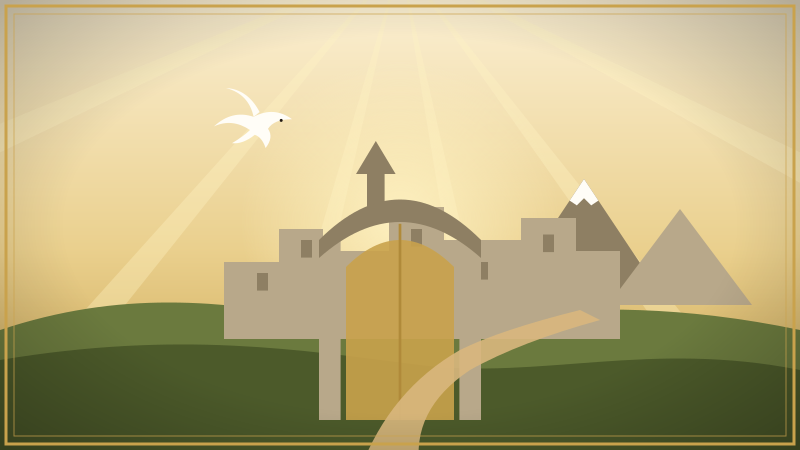
I have sat with people at the end of their lives, and I will tell you what they ask. They do not ask about their careers. They do not ask about their houses. They ask, what is on the other side? That is the honest question of every human heart, and God has not left us guessing. He has told us enough to fill us with hope, and He has left enough unsaid to keep us hungry. So let us open the Book and see what Scripture actually says of Heaven.
Start where the Lord Jesus Christ started, on the last night before the cross, with His disciples' hearts breaking. He said, "Let not your heart be troubled: ye believe in God, believe also in me. In my Father's house are many mansions: if it were not so, I would have told you. I go to prepare a place for you." Notice three things in that one word. It is a house — a home, not a warehouse for souls. It is the Father's house — the place belongs to Him, and if you are His child you are not a visitor there. And it is prepared — by the same hands that were nailed to the tree. Heaven is not a reward you negotiate; it is a place a Person went to get ready for you.
Scripture also calls it Paradise. When the thief on the cross had nothing left to offer — no time, no works, no reputation, only a cry — the Lord Jesus Christ said to him, "Verily I say unto thee, To day shalt thou be with me in paradise." Today. Not after centuries of waiting. The moment that man's breath stopped, he was with the Lord. And Paul, who knew that country by experience, wrote of a man "caught up to the third heaven" and "caught up into paradise, and heard unspeakable words, which it is not lawful for a man to utter." Understand what he is telling us. He was there. He saw it. And the language of earth could not carry it back.
The third heaven is simply Scripture's way of naming the height of it. The first heaven is the sky where the birds fly; the second is the expanse where the stars burn; the third is the very dwelling of God. That is where Paul was taken, and that is the destination of the redeemed. And here is the heart of the whole matter: what makes Heaven Heaven is not the streets and it is not the gates. It is God Himself. David said it plainly, "in thy presence is fulness of joy; at thy right hand there are pleasures for evermore." Paul said he was "willing rather to be absent from the body, and to be present with the Lord." Take God out of Heaven and there is nothing left worth having.
That is why Heaven is the exact opposite of hell in every direction. We have taught you that hell is the opposite of God — He is rest and peace, and there is no rest in that place. Turn it around and you have Heaven. Where God is fully present, there is fullness of joy, fullness of rest, fullness of peace. John saw it and wrote, "And God shall wipe away all tears from their eyes; and there shall be no more death, neither sorrow, nor crying, neither shall there be any more pain: for the former things are passed away."
Sit with that promise a moment, because it is more tender than we usually let it be. It does not say the tears are ignored. It says God shall wipe them away — His own hand to your face. Every funeral you have stood through, every hospital corridor, every night you cried where nobody heard you — He knows the count of them, and He Himself will end them. The mothers who buried children, the saints who suffered for the Gospel and were never thanked: their tears are dried by the hand of God.
And then there is the word that stops all our speculation. "But as it is written, Eye hath not seen, nor ear heard, neither have entered into the heart of man, the things which God hath prepared for them that love him." Do not rush past that. It is not merely that you have not seen it. It has never even entered into the heart of man. The best thing you have ever imagined about Heaven is too small. Your finest hour of worship, your sweetest day of peace, the most beautiful place you ever stood — all of it is a shadow on the wall compared to what is prepared for those who love Him.
So do not let anybody tell you the believer's hope is a vague, harp-playing boredom in the clouds. It is a home, prepared by the Lord Jesus Christ, in the presence of God, without tears, beyond imagination, and the sons of God will rule with Him there. The only question that matters is whether you belong to Him. Everything else in this course flows from that one question.
2. The Resurrection of the Body and the New Jerusalem
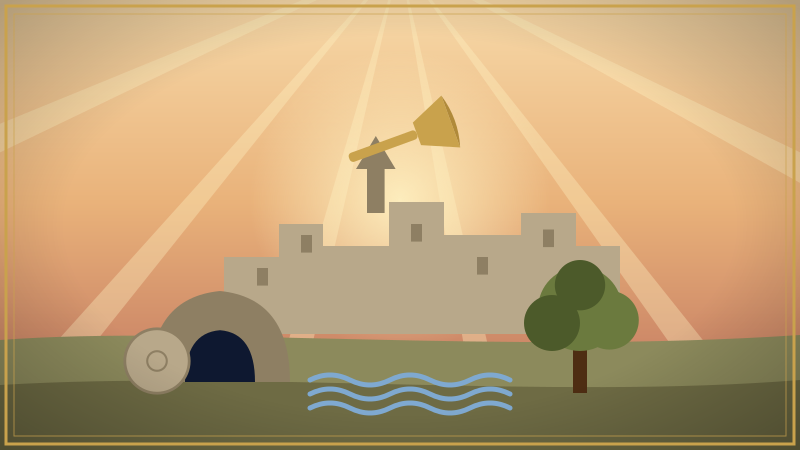
Some believers think the whole hope of the Gospel is that your soul floats off somewhere pleasant when your body gives out. That is not the Christian hope. It is only half of it, and the smaller half. The full hope of the Gospel is resurrection — that this body, the one that aches and ages and is finally laid in the ground, will be raised. God is not finished with the dust He formed. He is going to raise it in glory.
Paul lays it out like a farmer talking about a field. "So also is the resurrection of the dead. It is sown in corruption; it is raised in incorruption: It is sown in dishonour; it is raised in glory: it is sown in weakness; it is raised in power: It is sown a natural body; it is raised a spiritual body." Sown and raised — that is the language of planting, not of throwing away. What goes into the ground is not garbage; it is seed. And the body that comes up out of that ground is the same person, gloriously changed: no corruption in it, no dishonour on it, no weakness left in it.
Then Paul tells us the mystery for those who are still alive when He comes. "Behold, I shew you a mystery; We shall not all sleep, but we shall all be changed, In a moment, in the twinkling of an eye, at the last trump: for the trumpet shall sound, and the dead shall be raised incorruptible, and we shall be changed." A moment. Faster than you can blink. And the reason it must happen is stated in the next breath: "For this corruptible must put on incorruption, and this mortal must put on immortality." Flesh as it now stands cannot carry eternity. So God will re-clothe us for the world He is bringing.
Paul described the same day to a grieving church in Thessalonica. "For the Lord himself shall descend from heaven with a shout, with the voice of the archangel, and with the trump of God: and the dead in Christ shall rise first: Then we which are alive and remain shall be caught up together with them in the clouds, to meet the Lord in the air: and so shall we ever be with the Lord." Notice the order, because it comforts the bereaved: the dead go first. Those you have buried in the Lord are not behind in the line; they lead the procession. And notice the destination — not merely a place, but a Person. So shall we ever be with the Lord.
Now lift your eyes further, because God's plan is bigger than saving individuals out of a doomed world. He is remaking the world. "And I saw a new heaven and a new earth: for the first heaven and the first earth were passed away; and there was no more sea." And the great announcement that follows is the sentence the whole Bible has been building toward: "Behold, the tabernacle of God is with men, and he will dwell with them, and they shall be his people, and God himself shall be with them, and be their God." Eden was lost and God walked away from a garden; here God moves in permanently with His people.
John was carried to a high mountain and shown the city, "that great city, the holy Jerusalem, descending out of heaven from God." He describes walls of jasper and gates of pearl, foundations garnished with precious stones, a street of pure gold, twelve gates that are never shut because night never comes. He tells us the city needs no temple, for the Lord God Almighty and the Lamb are the temple of it, and it needs no sun, "for the glory of God did lighten it, and the Lamb is the light thereof." Through the middle of it runs "a pure river of water of life, clear as crystal, proceeding out of the throne of God and of the Lamb," and the tree of life stands on either side, bearing twelve manner of fruits, its leaves for the healing of the nations. This is not a myth. This is a real city with real citizens, and the gate of it is guarded by one requirement: nothing that defiles enters, but only "they which are written in the Lamb's book of life."
And what will the redeemed do there? Not drift. Not idle. Scripture says of the servants of God in that city, "And there shall be no night there; and they need no candle, neither light of the sun; for the Lord God giveth them light: and they shall reign for ever and ever." We have taught you already that the sons of God will rule with Him, and here is where that ruling is finally seen. All creation is waiting for it — "For the earnest expectation of the creature waiteth for the manifestation of the sons of God." The groaning earth is waiting to see who God's children really are.
So bury your dead in hope. Carry your aching body in hope. That grave is a seedbed, and the God who raised the Lord Jesus Christ from the dead has bound Himself to raise you also. The last word over your life will not be spoken by a cemetery. It will be spoken by a trumpet.
3. Hell, Death, and the Lake of Fire
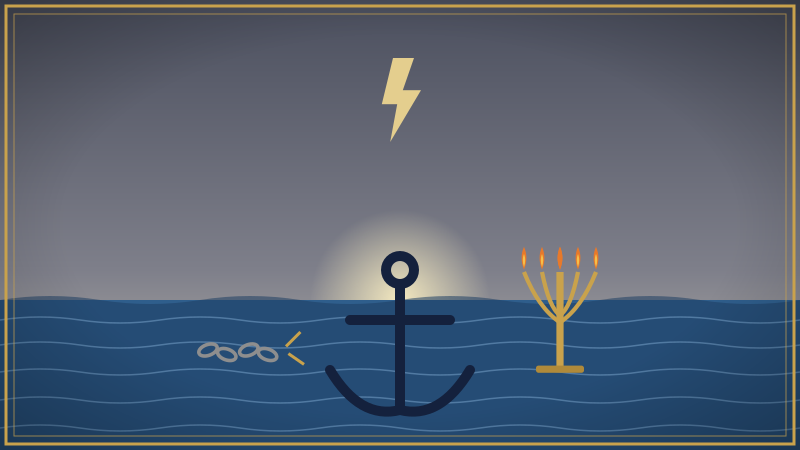
I do not preach on this subject because I enjoy it. I preach it because the Lord Jesus Christ preached it more than anyone else in Scripture, and a shepherd who will not warn the flock about the cliff is no shepherd. But we must be accurate. A great deal of confusion comes from lumping every word together and calling it all "hell." Scripture is more careful than that, and so must we be.
In the Old Testament the word is Sheol; in the New Testament it is hades. That is the realm of the departed dead, the holding place where the souls of the unrighteous are kept, conscious and waiting, until the day of judgment. It is real and it is terrible, but it is not the final address. The other word the Lord Jesus Christ used is Gehenna, and Revelation calls it the lake of fire. Hell and the lake of fire are not the same thing. Hell is the prison cell before the trial; the lake of fire is the sentence after it. Revelation states it in one sentence: "And death and hell were cast into the lake of fire. This is the second death." If hell itself is cast into the lake of fire, then hell cannot be the lake of fire.
What is that holding place like? The Lord Jesus Christ pulled the curtain back Himself in Luke 16. A rich man lived in luxury and stepped over a beggar named Lazarus at his gate every day. Both men died. And He said, "And in hell he lift up his eyes, being in torments, and seeth Abraham afar off, and Lazarus in his bosom." Look at what that account teaches. The man was fully conscious. He had his memory — he remembered his five brothers. He had his senses — he begged for a drop of water on his tongue. Death did not end him; it relocated him. And Abraham answered that "between us and you there is a great gulf fixed," so that no one crosses over. There is no transfer window after death.
Now understand what makes that place what it is. We have taught you that hell is the exact opposite of God. God is rest; God is peace; God is light; God is life. Strip a soul of God and you have unrest, torment, darkness, and death. That is why Scripture says of the damned that "they have no rest day nor night." The fire is real, but the deepest agony of that place is the absence of the One who is rest. Every good thing you have ever tasted came down from the Father of lights. Take Him away entirely, and what is left is hell.
Then comes the day when the temporary becomes permanent. "And the sea gave up the dead which were in it; and death and hell delivered up the dead which were in them: and they were judged every man according to their works." The holding place empties out. Every soul stands before God. And then the final sentence: "And whosoever was not found written in the book of life was cast into the lake of fire." Scripture calls this the second death — not annihilation, but eternal separation, a death that never finishes dying. The first death separates the soul from the body. The second death separates the soul from God for ever.
And here is a truth that answers half the arguments people bring. The lake of fire was never designed for you. The Lord Jesus Christ said, "Depart from me, ye cursed, into everlasting fire, prepared for the devil and his angels." Prepared for the devil and his angels. It was built as a prison for rebel spirits. No human being was ever in the blueprint. If a man ends up there, he has gone somewhere that was never made for him, following someone whose rebellion he chose to share.
So the question comes, and it is a fair one: how can a loving God have a hell? The answer is free will, and it is the answer we teach without apology. God made you a person, not a puppet. Love that cannot be refused is not love. He sent His Son, He sends His preachers, He sends His Spirit to convict, He is "not willing that any should perish, but that all should come to repentance" — but He will not drag a soul into His presence against its settled will. A person who truly does not want God is finally given exactly what he asked for: a place without Him. Hell is not God's cruelty; it is God's terrible respect for a decision.
Which is why I plead with you rather than frighten you. The Lord Jesus Christ said, "fear not them which kill the body, but are not able to kill the soul: but rather fear him which is able to destroy both soul and body in hell." Fear God, and you need fear nothing else. There is a cross standing between every sinner and that lake, and while you have breath the way is open. Do not wait for a more convenient day. There is a great gulf fixed on the other side, and no one has ever crossed it.
4. The Two Judgments
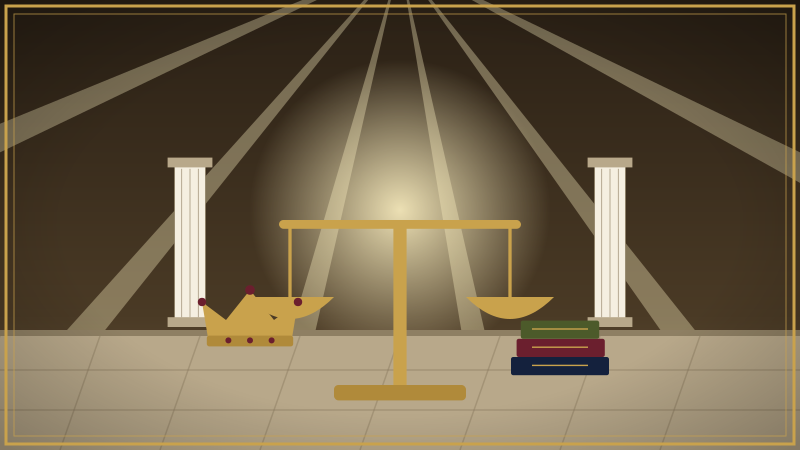
Everybody will stand before God. Nobody slips past. But Scripture does not describe one judgment; it describes two, and they are not for the same people, they do not use the same books, and they do not decide the same question. If you confuse them you will either terrify a believer who should be secure or comfort a sinner who should be trembling. So let us be careful and clear.
The first is the judgment seat of the Lord Jesus Christ, and it is for His own. Paul wrote, "For we must all appear before the judgment seat of Christ; that every one may receive the things done in his body, according to that he hath done, whether it be good or bad." Notice who is speaking and to whom. Paul says we — apostles, elders, saints, the blood-bought church. This is not a trial to determine whether you are saved. That question was settled at the cross and answered when you believed. This is a review of your works: what you did with what He gave you.
Paul illustrates it as a building inspection. "For other foundation can no man lay than that is laid, which is Jesus Christ." The foundation is fixed and it is not up for review. But then each of us builds on it, some with gold, silver and precious stones, some with wood, hay and stubble. And the inspection is by fire: "Every man's work shall be made manifest: for the day shall declare it, because it shall be revealed by fire; and the fire shall try every man's work of what sort it is." Fire does not destroy gold; it purifies it. Fire eats stubble in a second. The fire is not testing the quantity of your work but the sort of it — what it was made of, and who it was really for.
Then Paul says something that should sober every one of us who preaches, sings, gives, or serves. "If any man's work shall be burned, he shall suffer loss: but he himself shall be saved; yet so as by fire." A man can reach Heaven and lose nearly everything he built on the way. Saved, yes — but empty-handed, watching a lifetime of showy religious activity go up in smoke because it was done for applause and not for the Lord. I would rather build small and build in gold. Let no man take your crown.
Because there are crowns. Scripture is not shy about rewards, and it is not carnal to want them; it is obedient. Paul at the end of his life wrote, "Henceforth there is laid up for me a crown of righteousness, which the Lord, the righteous judge, shall give me at that day: and not to me only, but unto all them also that love his appearing." Peter promised the faithful shepherd "a crown of glory that fadeth not away." And the Lord Jesus Christ warned a whole church, "Behold, I come quickly: hold that fast which thou hast, that no man take thy crown." A crown can be lost while a soul is kept. Hold fast.
The second judgment is another matter altogether, and Scripture names it the great white throne. John writes, "And I saw a great white throne, and him that sat on it, from whose face the earth and the heaven fled away; and there was found no place for them." Understand the picture. The universe itself cannot stand in that presence and flees; and a man who has refused the blood of the Lord Jesus Christ must stand there with nothing between himself and God. There is nowhere left to run. Creation itself has already run.
And then the books are opened. "And I saw the dead, small and great, stand before God; and the books were opened: and another book was opened, which is the book of life: and the dead were judged out of those things which were written in the books, according to their works." Two kinds of record are named. The books hold the deeds — every word, every act, every hidden thing, exactly and honestly recorded, so that no one there can accuse God of injustice. The book of life holds the names. And the deciding question at that throne is not how your record compares with your neighbour's; it is whether your name is written. "And whosoever was not found written in the book of life was cast into the lake of fire." Small and great alike — the throne is no respecter of persons, and there is no lawyer, no bribe, no influence, no second appeal.
So put the two side by side and let them do their work in you. If you belong to the Lord Jesus Christ, you will not stand at the great white throne, because your name is in the book of life and your sin was judged at Calvary; but you will give an account of your works, so live worthy of that day. If you do not belong to Him, no amount of decent living will help you at that throne, because the question there is your name, not your résumé. Get your name written. Then spend the rest of your life building with gold.
5. Living in the Light of Eternity
Doctrine that never changes how you live on Monday is not doctrine; it is decoration. Everything we have studied — the Father's house, the resurrection, the city, the throne, the lake of fire — was not given to satisfy our curiosity. It was given to change the way we spend our days. So let me bring it home. How does a man or woman live who genuinely believes eternity is real?
First, such a person changes where they put their money and their effort. The Lord Jesus Christ said, "Lay not up for yourselves treasures upon earth, where moth and rust doth corrupt, and where thieves break through and steal: But lay up for yourselves treasures in heaven, where neither moth nor rust doth corrupt, and where thieves do not break through nor steal." He is not scolding you for having a job or a savings account. He is telling you the plain economics of eternity: everything here rots, rusts, or gets stolen, and nothing there ever does. Then He gives the reason it matters so much: "For where your treasure is, there will your heart be also." Your heart follows your treasure, not the other way around. Move the treasure and the heart will come after it.
Second, such a person guards their time. "Redeeming the time, because the days are evil." To redeem is to buy back. Paul is telling us that time is being stolen from us all day long and we must go and buy it back deliberately — from the screen, from the argument, from the endless entertainment that leaves nothing behind. I am not asking you to be grim. I am asking you to be awake. You have a fixed number of mornings, and not one of them can be returned to you. Get up and pray. Give Him hours nobody sees, because those are the hours that build in gold.
Third, such a person endures. "But he that shall endure unto the end, the same shall be saved." Notice the Lord does not promise the crown to the one who starts loudest, or the one with the greatest gift, or the one with the largest congregation. He promises it to the one who is still standing at the end. I have watched people begin with fire and drift away over a disappointment, an offence, a betrayal, a season when God seemed silent. Beloved, hold on. Endurance is not glamorous; it is just refusing to quit on a God who has never once quit on you.
Fourth, such a person cannot keep quiet. If what we studied about the lake of fire is true, then everyone you passed today is walking toward one destination or the other, and there is no crossing over afterward. That is the fire behind evangelism, and as ministers such as T. B. Joshua have taught, boldness for souls is not a personality type — it is what the fear of God and the love of God produce in an ordinary believer. Solomon said, "he that winneth souls is wise." Daniel said, "they that turn many to righteousness as the stars for ever and ever." There is no investment on this earth with a return like a soul. Speak to your neighbour, speak to the man at your work, speak to your own household, which is often the hardest place of all. And speak in this generation, because you do not have another one.
Fifth, such a person is made clean by their own hope. John wrote, "Beloved, now are we the sons of God, and it doth not yet appear what we shall be: but we know that, when he shall appear, we shall be like him; for we shall see him as he is. And every man that hath this hope in him purifieth himself, even as he is pure." Do not miss the mechanism. Holiness here is not produced by fear of getting caught, or by rules pinned to a wall. It is produced by hope. A man who honestly expects to see the Lord Jesus Christ face to face, and to be made like Him, begins to clean up his life on his own — because he is getting ready for a Person. The hope purifies him.
And so we set our affections deliberately. "Set your affection on things above, not on things on the earth." That is a command, which means it is a choice you make, not a mood you wait for. Paul said the things which are seen are temporal, but the things which are not seen are eternal. The mortgage feels more real than the throne. But feeling is not fact. The unseen things are the lasting ones, and the seen things are already passing away while you look at them.
Let me close where we began this course. The sons of God will rule with Him. There is a home prepared, a body waiting to be raised, a city coming down, and tears that God Himself will wipe away with His own hand. That is your inheritance if you are His. So do not live small, and do not live for what rots. Lay up your treasure where it cannot be touched, buy back your time, endure to the end, open your mouth for souls, and keep yourself pure for the day you see His face.
Assessment
Fifteen questions. The passing standard is 80%; 90% or above is awarded with honors. Answer every question, then submit. The questions and their answers are placed in a different order every time.
Return to the Reading First
The assessment was not passed. Go back through the reading, then come back. The assessment reopens in
Every question needs an answer before you submit.